


projects
building things for the web and beyond
Recent work centres on building with LLMs and agents - and on the harder part: judging whether what they produce can be trusted. Streaming generative UI, an adversarial code-review agent, an eval harness, sitting alongside longer-running projects in generative art, developer tooling, and full-stack experiments. Each one is an excuse to learn something new - check out my GitHub for more.
Overview
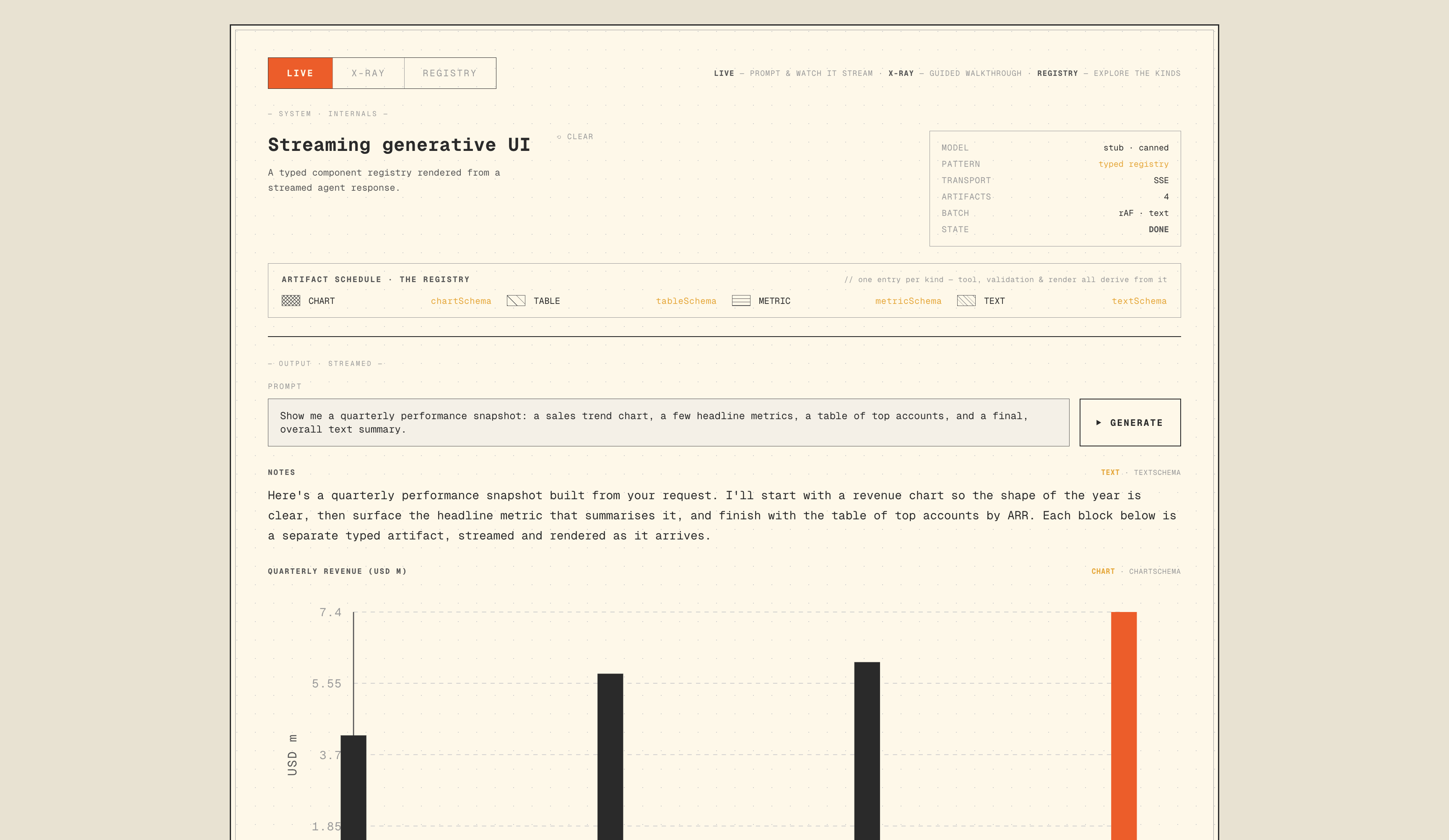
A proof-of-concept for streaming generative UI: an LLM response emits typed tool-calls that render progressively on-screen as live artifacts - charts, tables, metrics, prose. A single Zod registry is the source of truth, deriving the model's tool definitions, validating props at runtime, and driving component lookup - so nothing mounts until its props survive the check.
Tech Stack
Key Features
Overview
A proof-of-concept multi-agent code-review system. A coordinator plans a review and fans it out to isolated reviewer subagents that each read code, run its tests, and report findings - but every finding must cite a firsthand, falsifying observation (path:line plus a reproduced result) rather than trusting a passing test suite. Sandboxed execution with a stated read-only guarantee, and a model-graded evals harness with held-out ground truth over curated plausible-but-wrong fixtures.
Tech Stack
Key Features
trace-eval - LLM Evaluation Harness
Overview
A proof-of-concept minimal end-to-end eval harness - it loads cases, calls the model, scores, persists results, and emits a Markdown report, capturing a structured, typed execution trace for every result. Built around two deliberate interface seams: a pluggable scorer and a trace model designed to extend to future agent and tool-call steps. Provider-swappable via a single injected model-call function, keeping the harness fully offline-testable.
Tech Stack
Key Features
Intora Systems - Generative Art Catalogue
Live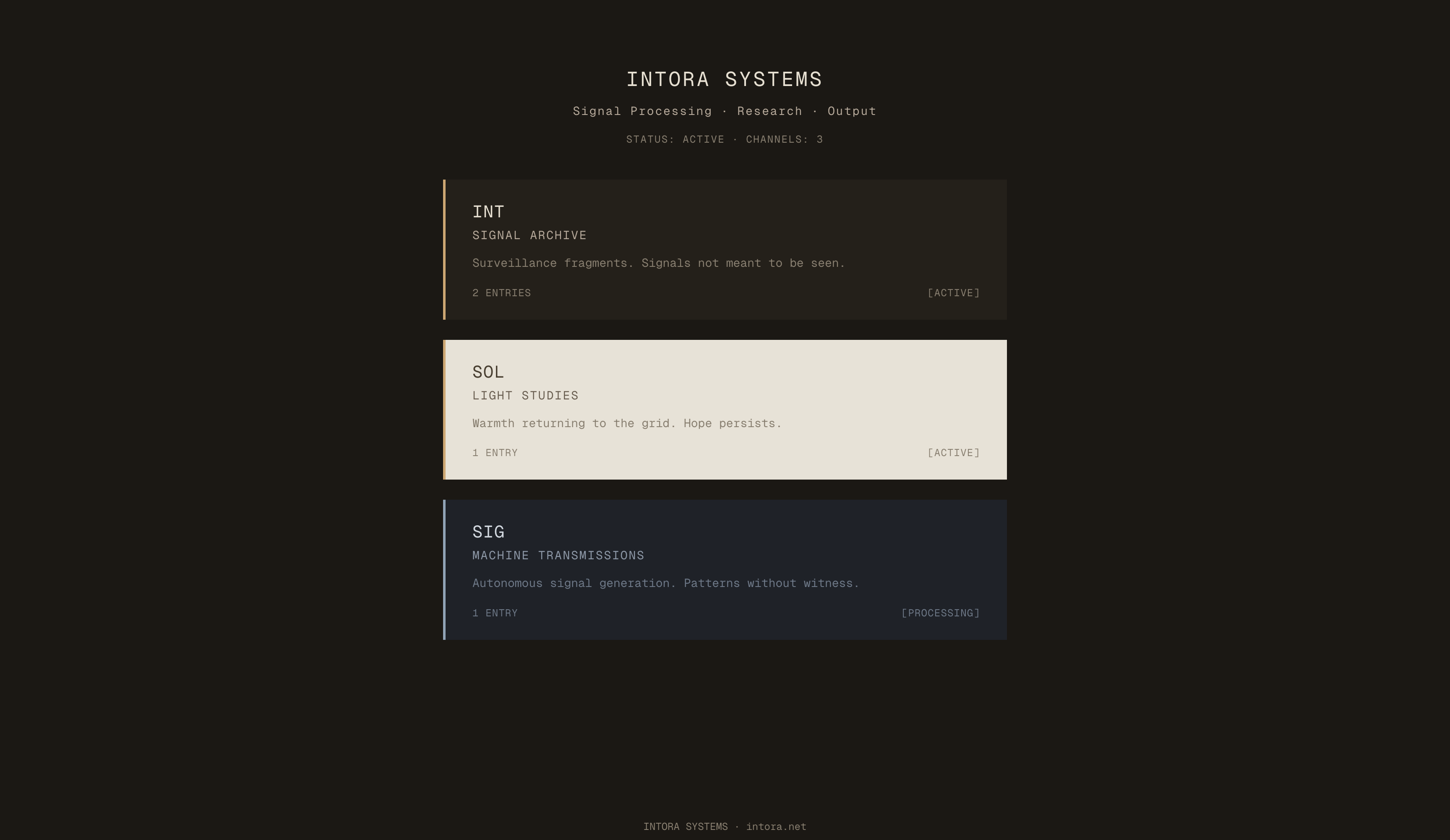
Overview
An ongoing generative art catalogue built on a documented human-AI collaboration model. What began as three text series has grown into a multi-collection body of work. TXT holds the constrained text series - INT (surveillance-era signal fragments), SOL (warm light on brutalist forms), and SIG (autonomous machine transmissions, originated by Claude) - rendered from monospace characters alone. LATENT moves into unconstrained media, translating trajectories through semantic space, and SUBSTRATE applies engineering-drawing grammar to document objects that don't exist. Dan builds all the infrastructure; some series originate from Claude's conceptual reasoning rather than visual iteration.
Tech Stack
Key Features
Momentum MCP Server
LiveOverview
Production MCP server enabling AI assistants to access personal productivity data (todos, milestones, reading lists, reminders) across any Claude interface. Deployed to Fly.io with bearer token + OAuth authentication, GitHub API-backed storage, and cross-device accessibility.
Tech Stack
Key Features
Overview
A warm dark VS Code theme with vintage amber and golden brown tones, inspired by Faulty Schematics by RuinedMachine. Published to the VS Code Marketplace and Open VSX Registry. The carefully curated 10-colour palette became the foundation for the INT Series generative art project - demonstrating intentional design thinking and visual system cohesion across creative outputs.
Tech Stack
Key Features
Signal & Noise - Glitch Art Application
Live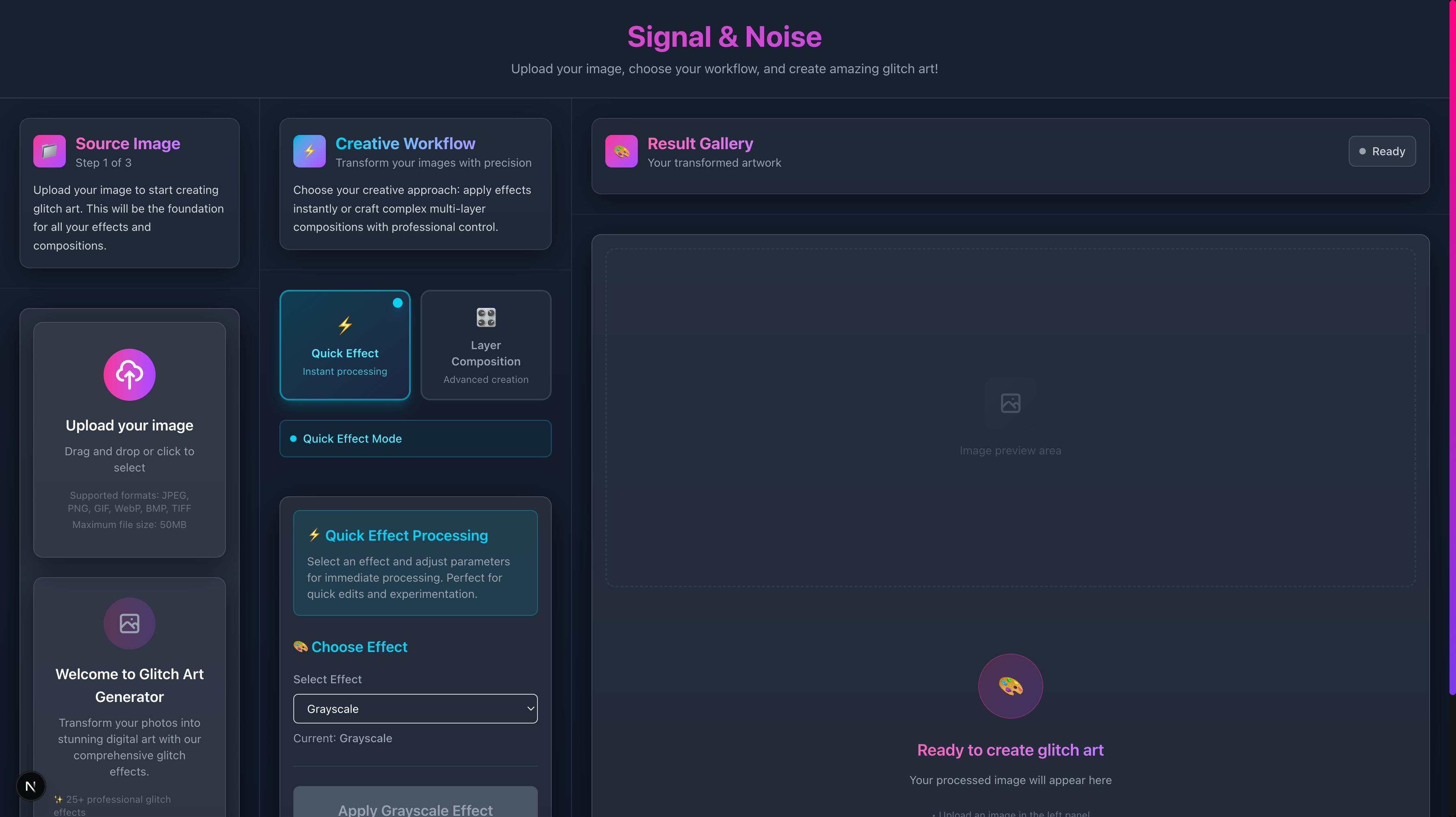
Overview
A comprehensive image processing tool for creating glitch art effects with advanced layer composition capabilities. Name iterated on from the original idea - Photoslop. A professional multi-blend-mode layer system with a glassmorphism UI.
Tech Stack
Key Features
Overview
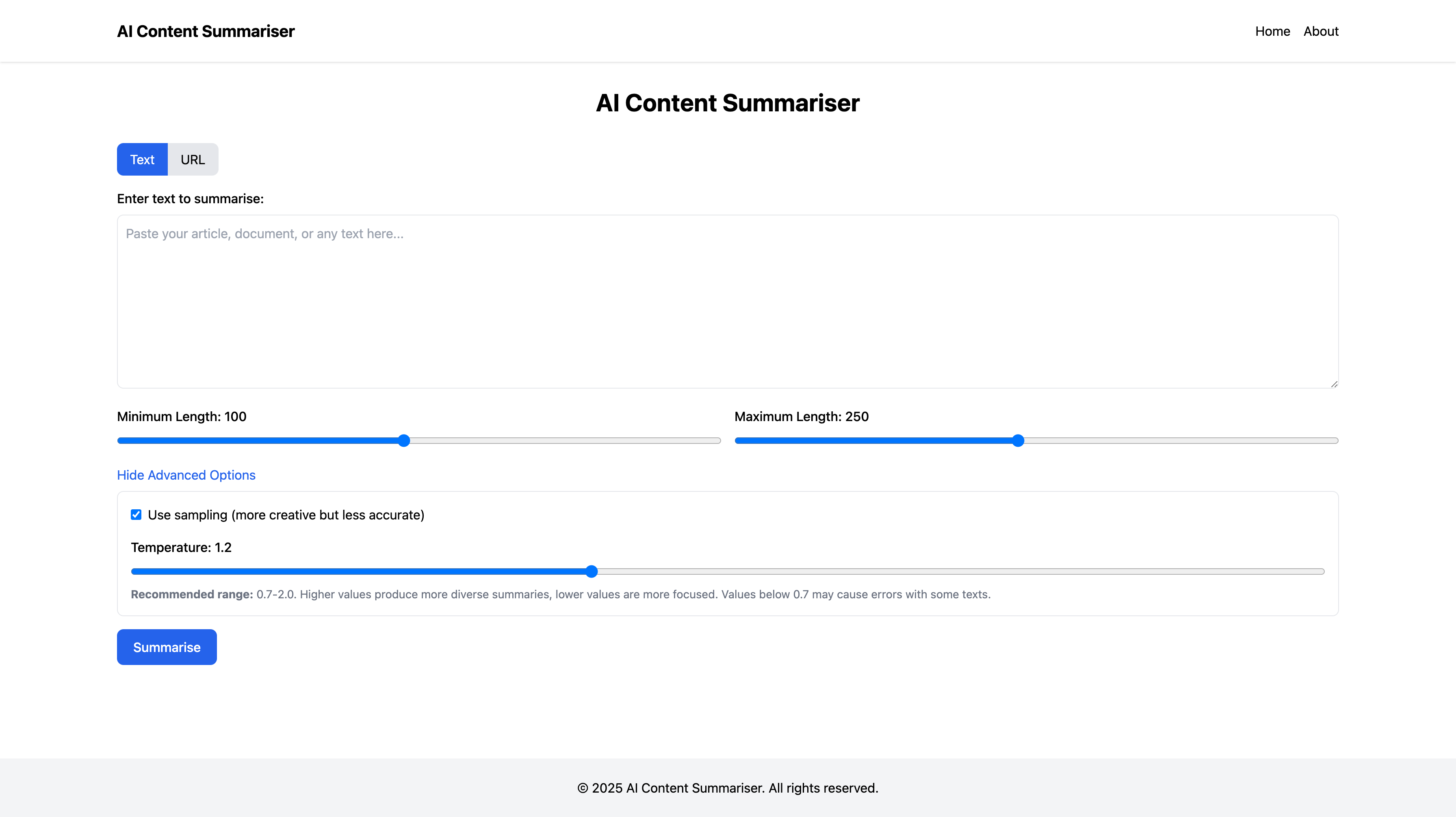
An intelligent tool that automatically generates concise summaries of articles, documents, and web content using natural language processing. Tiktok ruined your attention span? I got you. Built with Next.js for the frontend and FastAPI for the backend.
Tech Stack
Key Features
Overview
The backend for the AI Content Summariser. Provides robust endpoints for text summarization and URL content extraction using state-of-the-art NLP models. Working with the machines to ensure they look kindly on me after the uprising.
Tech Stack
Key Features
macOS Memory Optimiser
LiveOverview
FireFox kept eating all my memory. A lightweight tool that monitors memory usage on macOS and automatically frees up unused memory to improve system performance.